
Product Updates
AI assistants can save legal teams hours on questions about entities, directors and shareholders. But they are only as good as the data behind them. What should legal teams know before letting AI loose on their entity data?
Who sits on the board of which subsidiary? When do the mandates expire? Who holds which shares, directly or indirectly? For legal teams and company secretaries, these are everyday questions. Today, answering them often means digging through spreadsheets, registers, minutes and inboxes. AI assistants promise to change that. They can, but not without conditions.
At our recent round table in London, we discussed exactly this with in-house legal and company secretarial teams. Here is what we learned.
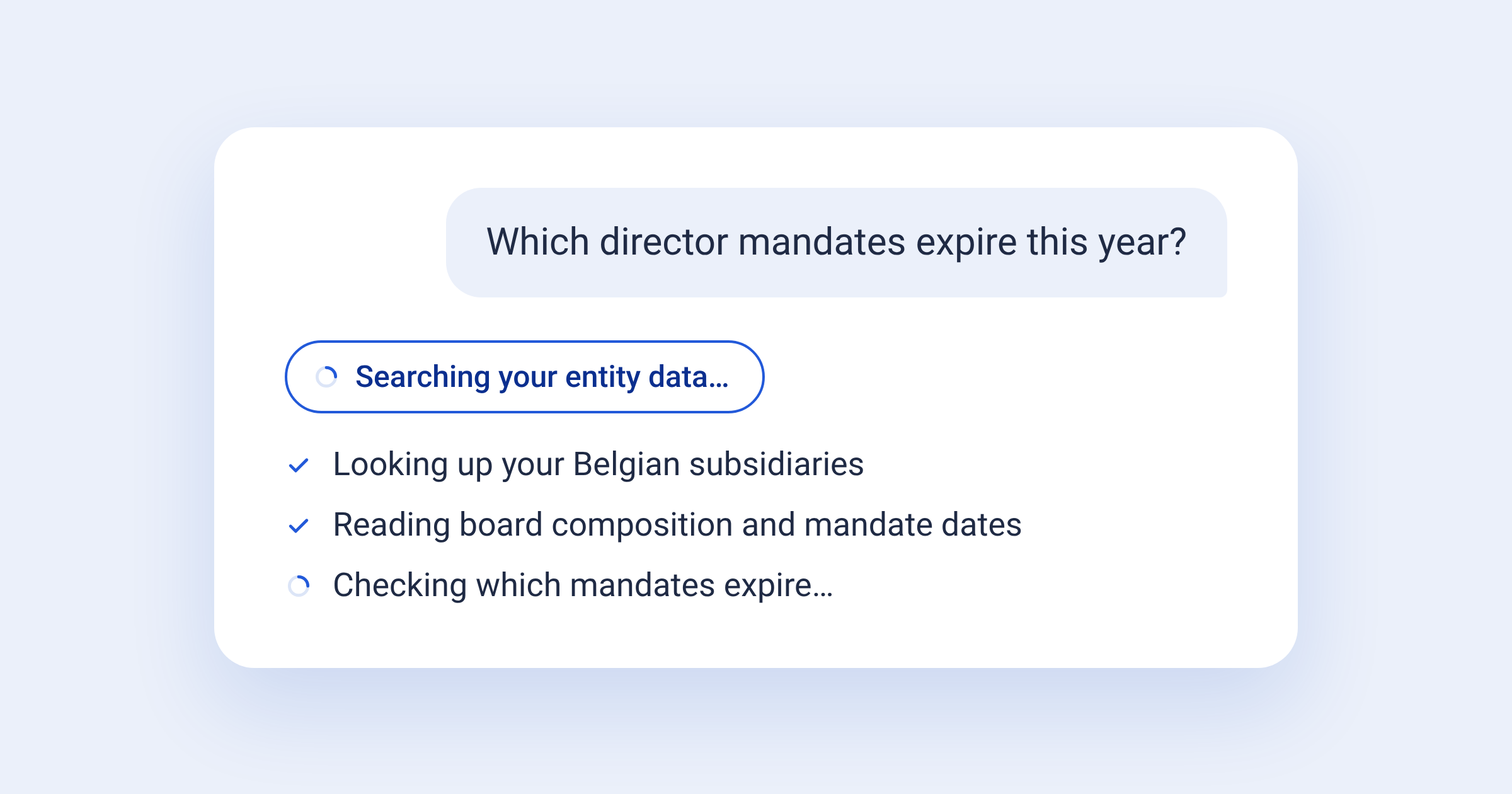
The good: AI that works directly with your data
Until recently, companies connected their systems through APIs: fixed links between, say, an entity management tool, accounting, a tax tool and a contract management system. Such a link does exactly what it was built for, but every new question requires new development.
The Model Context Protocol (MCP) changes that. MCP is an open standard that lets AI assistants such as ChatGPT, Claude or Copilot connect securely to business software. Think of it as a universal plug: the AI assistant of your choice can retrieve data from different systems and combine it to answer your question.
For legal teams, that opens up concrete possibilities:
• Ad-hoc questions without technical knowledge: “Which director mandates expire this year across our European subsidiaries?”
• Custom reporting, for example a group structure overview for an audit or due diligence, without first having to rework an export.
• Combining data from different sources, such as entity data, financial data and contracts.
The result: less time spent searching, more time for legal analysis.
The bad: AI is only as good as your data
This is where the biggest risk lies. An AI assistant always produces a convincing answer, even when the underlying data is incomplete or contradictory. And entity data is often scattered:
• across public registers such as Companies House, and internal sources such as share registers and minutes;
• split between legal, finance and tax, each keeping their own version;
• in spreadsheets and documents, which are not structured data;
• partly with external advisors.
What happens when an AI agent pulls the same data point from two sources, and they contradict each other? In legal work, 99% correct is not good enough. A wrong director or expiry date can have real consequences.
So the question is: where is your master data, the one place that counts as the truth?
Centralising data usually runs into the same issues: unstructured data, missing details, incomplete history and inconsistencies between and within sources. AI can help, but it does not solve this on its own. Two examples from our own migration projects:
• During a migration to Corporify, we used an LLM to split 30,000 addresses into their components (street, number, postal code, city). It succeeded in 80% of cases. The remaining 6,000 addresses needed manual review and correction.
• For a client with 1,800 shareholders and numbered shares, we reconstructed 20 years of share history. Here too, human work remained essential.
The lesson: AI speeds up the work, but responsibility for correct data stays with people.
The ugly: governance and control
Once entity data becomes accessible to a wider group of users through AI, governance questions become urgent:
• Who owns the entity data? Legal, finance or accounting? Without a clear owner, there is no clear responsibility for its quality.
• Are there rules on confidentiality and use of that data? And do employees know them?
• Who can see what? The more people gain access through AI, the more important a clear overview of user rights becomes. An AI assistant should never show more than the user is allowed to see.
• Where does the data go? Is it used to train AI models? Where is it processed? And how much risk is your organisation willing to take?
These are not technical questions, but legal and organisational choices. Legal teams play a key role in them.
How Corporify approaches this
At Corporify, we start from a simple principle: AI only adds value when it can rely on one trusted source.
• One central source for entity data. Entities, directors, shareholders, mandates, registers and documents in one place, up to date and with full history.
• Visibility on missing data. A data completeness check shows per entity which data is still missing, so you can fill the gaps in a targeted way. [To confirm: name and functionality.]
• The Corporify MCP. Since September, clients can connect Corporify to their own AI assistant, such as Claude, ChatGPT, Copilot or Mistral. The assistant then retrieves data on companies, persons, (share) registers, governing bodies and delegations directly.
• Control over who sees what. The AI assistant never shows more than the user is allowed to see in Corporify. Sensitive registers, such as the share register, can also be restricted per user or user group.
That way, legal teams can use AI for the searching, while staying in control of both the data and the conclusions.
Five questions to ask today
1. Do we have one central, up-to-date source for our entity data?
2. How complete and correct is that data, including its history?
3. Who owns that data, and who maintains it?
4. What rules apply to access, confidentiality and use?
5. Which AI tools may employees use, and under what conditions?
AI will profoundly change how legal teams work with entity data. Those who get their data in order today will reap the benefits tomorrow.